Carry Trade is not in DeFi, it should
Source: http://x.com/i/article/2054176414601981952
Macro funds have done this for decades with JPY and AUD. DeFi has stablecoins in every major fiat denomination, composable lending protocols, and permissionless execution. Every ingredient for an on-chain carry trade exists. Nobody runs it. This report explains why, and what it would take.
§1. Mechanism
FX looping applies the same recursive leverage structure as ETH/stETH or sDAI looping, but across currency denominations rather than within a single asset.
The capital flow per iteration: deposit USDC into a lending protocol, borrow EURC against that collateral, swap EURC back to USDC on a DEX, re-deposit the USDC, repeat. Each loop increases effective exposure to the interest rate spread between the two currencies while adding swap fees, gas costs, and (if hedged) FX hedging costs.

FX Looping Capital Flow per Loop Iteration
At LTV = 0.75, three loops convert $1.00 of initial capital into $2.73 of effective deposits and $1.73 of effective borrowing. The gross return is the deposit rate earned on $2.73 minus the borrow rate paid on $1.73. The net return subtracts swap fees (6 swaps across 3 loops), gas costs, and FX hedge costs.
The TradFi equivalent is the FX carry trade: borrow JPY at near-zero rates, convert to AUD or BRL, earn the higher yield, post as margin with a prime broker, borrow more JPY. The economic exposure is identical. The execution layer differs.

TradFi vs On-Chain FX Carry Trade
Two structural differences matter:
- TradFi carry trades operate through prime broker rehypothecation with 5-20x leverage available through bilateral margin agreements. On-chain looping is capped at approximately 3.3x effective leverage (L=0.75, N=5) by the protocol's LTV ceiling.
- TradFi FX markets provide $9.6 trillion per day in OTC liquidity for hedging. On-chain EUR perpetual open interest across all venues peaks at$1-10M.
§2. Infrastructure Gap
A prerequisite for FX looping: the lending protocol must accept both USD and non-USD stablecoins as collateral and borrowable assets. This prerequisite is barely met.

Non-USD Stablecoin Landscape
Of 10 non-USD stablecoins surveyed (EURC, EURS, EURA, XSGD, BRZ, TRYB, GYEN, CADC, NZDS, MXNT), only three have any presence on mainstream lending protocols: EURC (Circle), EURe (Monerium, Gnosis-native), and EURS (Stasis). The remaining seven have zero lending market support across Aave, Compound, Morpho, Venus, and Spark.
EURC holds 41% EUR stablecoin market share. Its total supply on Aave V3 Ethereum is $53.6M, with $32M already borrowed. Available liquidity for a new FX looper: roughly $20M, and that number fluctuates with utilization.
For context, BIS Bulletin 90 estimated the JPY carry trade at approximately $250 billion (¥40 trillion) before the August 2024 unwind. The entire on-chain EUR stablecoin lending market is 0.02% of that.
The EUR stablecoin sector is also contracting. Angle Protocol's EURA is shutting down following a March 2026 DAO vote, with a one-year redemption window through approximately March 2027. EURS has experienced multiple depegs to $1.21. The sector has functionally converged to EURC as the sole viable EUR stablecoin with lending protocol support.
§3. Maths
The closed-form net APY for N loops at LTV L, with supply rate r_s, borrow rate r_b, and per-loop costs:
- Effective deposits after N loops: D_N = (1 - L^N) / (1 - L)
- Effective borrowing after N loops: B_N = L × (1 - L^N) / (1 - L) = L × D_N
- Gross APY = r_s × D_N - r_b × B_N = D_N × (r_s - L × r_b)
The term (r_s - L × r_b) is the per-unit spread. If this term is negative, every additional loop amplifies losses. At current Aave V3 Ethereum spot rates (r_s = 3.47%, r_b = 3.67%, L = 0.75): per-unit spread = 3.47% - 0.75 × 3.67% = 0.72%. Positive, but thin. After subtracting swap fees, gas, and FX hedge costs, the net collapses.

APY Waterfall
The waterfall tells the full story. Start with the gross spread multiplied by effective leverage: -0.55% (negative because the borrow rate exceeds the supply rate after leverage adjustment). Add back the borrow-rate baseline of +3.67% to reach the gross lending return of +3.12%. Then subtract swap fees, gas costs, FX hedging at 1.5% annualized, and protocol fees. Net APY: -0.09%.
Looping converts a 3.47% risk-free supply rate into a -0.09% return. A depositor who does nothing earns more than a depositor who loops.
Benchmark comparison confirms the structural problem:
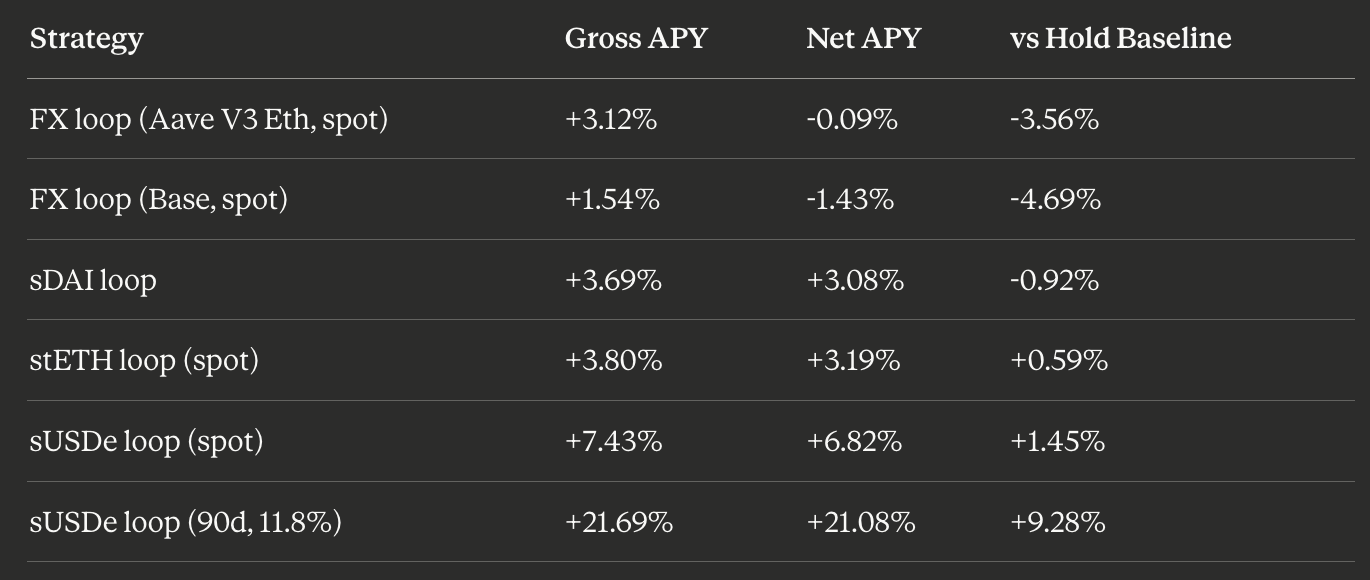
sUSDe looping generates +6.82% net APY and beats the hold baseline by 1.45 percentage points. FX looping generates -0.09% and trails the hold baseline by 3.56 percentage points. The difference is not marginal. sUSDe looping creates value; FX looping destroys it.
Here's why: sUSDe, stETH, and sDAI all carry native yield embedded in the asset itself (Ethena's funding rate, ETH staking rewards, Maker's DSR). The spread between supply and borrow rates on these assets reflects a genuine yield source at the protocol level. FX looping has no native yield. The spread between USDC supply and EURC borrow is a function of central bank policy rates in two jurisdictions, transmitted through oracle prices and protocol utilization curves, with no protocol-level yield source anchoring the spread.
§4. Why TradFi Works But DeFi Does Not
The FX carry trade has been a core macro hedge fund strategy for decades. The trade is structurally identical to FX looping. The returns have been positive for extended periods. The question is why the same strategy fails on chain.

Access Requirements Comparison
The access barrier comparison favors DeFi: $100 minimum vs
$500K+, minutes vs months, permissionless vs gated. But access barriers are irrelevant when the strategy itself produces negative returns. Democratizing access to a value-destroying trade is not a feature.
TradFi carry works because the infrastructure enables it: deep OTC liquidity compresses hedging costs, prime broker rehypothecation amplifies leverage to 5-20x, and mature derivatives markets allow precise risk management. On chain, each of these advantages is absent or vestigial. EUR perp open interest of
$1-10M means a $5M FX looping position cannot be hedged on chain without moving the market. Effective leverage caps at 3.3x. Swap slippage on EURC/USDC pairs in any meaningful size erodes the already-negative spread further.
§5. The Carry Unwind: A Warning From TradFi
Even when FX carry works, it carries catastrophic tail risk. The 2024 JPY carry unwind is the canonical case.

2024 JPY Carry Unwind Timeline
The transmission mechanism for on-chain FX looping would be structurally similar but faster. EUR/USD appreciation increases the USD-denominated value of EURC debt. At L=0.75 with a liquidation threshold of 0.85, a 13% EUR/USD move (comparable to the 2024 JPY unwind) pushes LTV from 0.75 to 0.85, triggering liquidation. On chain, liquidation is atomic and immediate. There is no prime broker discretion, no margin call with a 48-hour cure window. The position is liquidated in the same block the threshold is breached.

Liquidation Risk Transmission
At 3x leverage, a 13% adverse FX move liquidates the position entirely. At the $250B scale of TradFi carry, this produced a multi-day market crisis. At the $53.6M scale of on-chain EURC, liquidation cascades would be absorbed by the protocol's liquidation engine without systemic impact, but the individual looper loses everything.
§6. What Would Make It Work
The core deficit is not strategy logic but yield source. FX looping fails because neither side of the trade carries native yield. Both USDC and EURC are non-yield-bearing assets whose lending rates are set by utilization dynamics, not by embedded returns from an underlying yield source.

Yield-Bearing FX Looping Structure
If yield-bearing non-USD stablecoins existed on major lending protocols (an sEUR equivalent embedding European government bond yield, structurally parallel to sDAI embedding US Treasury yield through the DSR), the FX looping equation changes. Both sides of the trade now carry native yield. The looper captures: USD-side native yield + EUR-side native yield differential + leveraged carry spread.
Break-even analysis on the Track 2 model, solving for the minimum USD-EUR native yield differential:

Current macro rates: US 3M T-bill approximately 4.5%, €STR 1.93% (ECB, May 7 2026). The spread of 2.57% exceeds the hedged beat-hold threshold of +2.06% by approximately 50 basis points. The macroeconomic conditions for viable FX looping already exist.
The infrastructure does not.
Three yield-bearing EUR primitives exist or are in development. Spiko's EUTBL has reached $1.01B market cap, embedding €STR-net yield of approximately 1.63%. Usual's EUR0 wrapper is deployed with savings mode pending activation. Backed's bC3M offers 3.6% yield but is restricted to institutional participants. None of these are listed as collateral on Aave, Morpho, or any major lending protocol. Governance proposals are pending. Estimated timeline to listing: 6-12 months.
The second constraint is hedging depth. Even if yield-bearing EUR stablecoins reach lending protocols, a looper holding a $1M position needs to hedge EUR/USD exposure. On-chain EUR perpetual open interest across Hyperliquid, GMX V2, and Synthetix V3 totals approximately
$1-10M. Institutional-grade hedging (supporting
$50M+ in open interest) does not exist on chain. Annualized hedging cost through available venues runs 1.5-2.5%, compressing the already-narrow spread.
The viable FX looping configuration requires two conditions: yield-bearing EUR stablecoin listed on a major lending protocol (one governance vote away), and on-chain EUR derivatives depth sufficient to hedge positions above $3M (no clear path to this in the near term). The first is plausible within 12 months. The second is a structural liquidity problem that scales only with broader adoption of non-USD DeFi.
Until both conditions are met, FX looping remains a strategy that costs more to execute than it returns. The spread between what TradFi can do with FX carry and what DeFi can do reflects the maturity gap in non-USD stablecoin infrastructure, not a flaw in the underlying logic.
FX looping just hasn't been built yet. @circle @aave @Morpho @Spiko_finance @ethena @UTechStables